

Trade Alliance to Promote Prosperity Supports Review of Tariffs on Phosphate Fertilizers
January 28, 2026
According to reports, the U.S. Department of Commerce is expected to begin tariff reviews in March that could lead to the termination of anti-dumping and countervailing duties imposed in 2021 on certain phosphate fertilizer imports from Morocco and Russia. TAPP supports the review and encourages lifting the tariffs for the benefit of American farmers and grocery consumers.
A January 2026 report by the Agricultural and Food Policy Center at Texas A&M University found that the countervailing duties imposed on Moroccan phosphate fertilizer imports led to higher fertilizer prices and placed significant additional costs on U.S. farmers over multiple growing seasons. According to the study, the tariffs increased prices of diammonium phosphate, one of the most widely used phosphorus fertilizers in the United States, by about 30%. The study estimated that the countervailing duties increased phosphorus fertilizer supply costs for U.S. producers by approximately $6.9 billion between the 2021 and 2025 growing seasons.
This is among the reasons that TAPP encourages the Department of Commerce to conduct a review of the tariffs. TAPP also encourages equally swift removal of this tax on U.S. farmers.
Trade Alliance to Promote Prosperity Applauds Lifting of Fertilizer Tariffs
November 17, 2025
The Trade Alliance to Promote Prosperity today applauded President Trump’s Executive Order 14257, which exempts from tariffs most fertilizers, including urea, ammonium nitrate, UAN, ammonium sulfate, TSP, DAP, and MAP.
After seven months in place, the tariffs have curbed fertilizer imports to the United States and have elevated the price of fertilizers. Fertilizers exempted from the tariffs include urea, ammonium nitrate, UAN, ammonium sulfate, TSP, DAP, and MAP.
The modification to the tariffs went into effect for goods imported starting November 13.
Most fertilizer-exporting countries, excluding Russia, faced tariff rates of 10-15%, with some facing up to 30% tariffs, resulting in major disruptions in the global fertilizer trade.
TAPP hopes the fertilizer supply chain will stabilize to the benefit of American farmers and grocery consumers.
Punitive Biden Phosphate Tariff on Morocco Hurts Farmers, Grocery Consumers
December 1, 2023
The United States under the Biden Administration’s Department of Commerce is moving once again to raise tariffs on phosphate fertilizers from Morocco just months after announcing a large cut in duties (from 19.97% to 2.12% in November 2023).
By the way: At the same time as the Commerce Department cut Moroccan phosphate tariffs last November, it increased the countervailing duty rate for Russian producer PhosAgro from 9.19% to 28.50%.
Now, the Commerce Department says that it will raise tariffs on phosphate imports from Morocco, which is home to 70% of the world’s phosphate reserves, from 2.12% to 14.21%. It is also moving to lower duties on Russian phosphate fertilizer from 28.5% to 18.83%.
The proposed new rates will go into effect in November 2024 and apply retroactively to 2022 imports. The changes come after Florida-based fertilizer company Mosaic petitioned the agency for action, saying tariffs are needed to create a competitive marketplace.
OCP, a state-owned entity and the largest Moroccan phosphate fertilizer manufacturer, stopped shipments to the United States as a result of the 2021 tariffs. The company resumed shipments once the tariffs were lowered. Presumably, OCP will once again stop shipping phosphate to the United States.
Phosphate fertilizer is used on basically every crop from corn and wheat to vegetables to fruits and citrus to cotton.
With such volatility in the phosphate fertilizer market, it comes as no surprise that overall grocery prices have increased more than 21% since the beginning of 2021. With an incoherently outlandish tariff regimen regarding Moroccan phosphates, the Biden Administration is causing artificial volatility in the ag input market and thus also in the supermarket.
What motivates the Biden Administration? It seems suspiciously political.
Most of the U.S. phosphate production comes from Florida and North Carolina, which happen to have been hotly contested in recent presidential elections. Here we are, coming up on another presidential election, and suddenly the Biden Administration is enacting trade policies that will benefit a bit Florida-based company. At the same time, tariffs on Morocco harm American farmers, who reside largely in conservative states with Republican representation in Congress.
Suspicious, indeed, and also unconscionable.
The production of (affordable) food is not just an economic issue but also a moral issue. About 9.2% of the world’s population, or about 735 million people, were undernourished in 2022, according to the United Nations, which was substantially higher than in 2019, when 7.9% of the population was undernourished. It could be considered a regression in human development when the ability to produce more and less expensive food exists but is not exercised. The high cost of ag inputs, including phosphate fertilizers, is partly to blame.
For all of these reasons, TAPP is calling on the Biden Administration to abandon its efforts to impose punitive tariffs on Moroccan phosphates and instead to help American farmers and grocery consumers through lowering the costs of producing food domestically.
Kaiser & Juday: How to Lower Skyrocketing Fertilizer Costs for Farmers
June 14, 2022
The price of fertilizer is not a topic that regularly makes its way into general news coverage. Enter Russia’s invasion of Ukraine , and for the past couple of months, there has been a flurry of stories in the press about fertilizer supply and prices with phrases such as “global shortage,” “skyrocketing prices,” and a resulting “food crisis.”
The heightened concern is warranted. Russia is the world’s largest exporter of fertilizers. The United States has a robust fertilizer manufacturing sector, but the overall balance of global supply and demand affects prices here in the U.S. as well as in other countries.
New sanctions on trade with Russia are justified and meant to restrict that country’s export revenue, but the pressure applied by sanctions effectively reduces the available supply of fertilizer on the global market.
As President Joe Biden recognized in his recent speech at NATO headquarters, “the price of these sanctions is not just imposed upon Russia. It's imposed upon an awful lot of countries as well, including European countries and our country as well."
However, the same is true for duties and tariffs placed on other sources of global fertilizer. That is in fact the case with Morocco and Trinidad and Tobago, key suppliers of fertilizers to the U.S. Those two reliable sources of needed fertilizer supplies for the U.S. are subject to needless and harmful tariffs that have already added costs to U.S. farmers’ bottom line and our food and feed value chain.
The Department of Commerce announced in November that it had made a preliminary determination to impose duties on urea ammonium nitrate, or UAN, imports from Trinidad and Tobago. The U.S. has already begun collecting preliminary cash deposits on imports, effectively imposing tariffs before the final decision. That process began in July of last year, and the market started pricing in the possible effect of the tariffs then. Further, the Biden administration is considering additional duties on UAN from Trinidad and Tobago.
Similarly, the Trump administration announced its decision in November 2020 to levy new tariffs on phosphate fertilizer imports from Morocco. Typically, a third or more of U.S. domestic phosphate fertilizer demand is necessarily supplied by imports. Morocco is home to 70% of the world’s phosphate reserves. Traditionally, the top three global exporters of phosphate fertilizers have, in order, been China, Morocco, and Russia. The duties imposed on Moroccan phosphates left a scant 15% of the world’s supply not subject to U.S. tariffs. In short, America’s dominance as an agricultural producer and exporter cannot be maintained without sufficient access to imported fertilizer.
Since the beginning of the process leading into the imposition of tariffs on phosphate fertilizers, through the third week of March (a month into the war), the price of monoammonium phosphate, a benchmark phosphate fertilizer product, has increased 125% , with 13% of the increase since Russia invaded Ukraine.
Since the tariff imposition process began for UAN, all nitrogen fertilizers have seen dramatic price increases because there is a degree of substitutability among the products. The best benchmark is anhydrous ammonia. Since July of last year, as tariffs were proposed and then preliminarily approved, anhydrous ammonia prices increased 273%. Only 4% of that increase has come since the war started.
It's true that the timing of the U.S. tariffs on phosphates and UAN added to the elements of a perfect storm of price pressure, including increased demand post-pandemic, additional planted acres, high crop prices, and supply chain disruptions, as well as weather disruptions and restrictions on natural gas production.
However, what prices need now is swift and targeted action, not diversions into the structure of the industry or the #PutinPriceHike social media campaign by the White House. As a bipartisan group of more than 80 lawmakers rightly pointed out in a letter to the International Trade Commission, reversing the U.S.-imposed tariffs on reliable suppliers such as Morocco and Trinidad and Tobago, tariffs that otherwise would remain in place for five years, provides “the most immediate opportunity for a near term, partial remedy to the high costs of fertilizer facing U.S. farmers before the end of the 2022 planting season.”
Kent Kaiser, Ph.D., is executive director of the Trade Alliance to Promote Prosperity. Dave Juday is the founder and principal at The Juday Group.
Trade Alliance to Promote Prosperity Thanks U.S. Congress Members for Opposing Fertilizer Tariffs
March 17, 2022
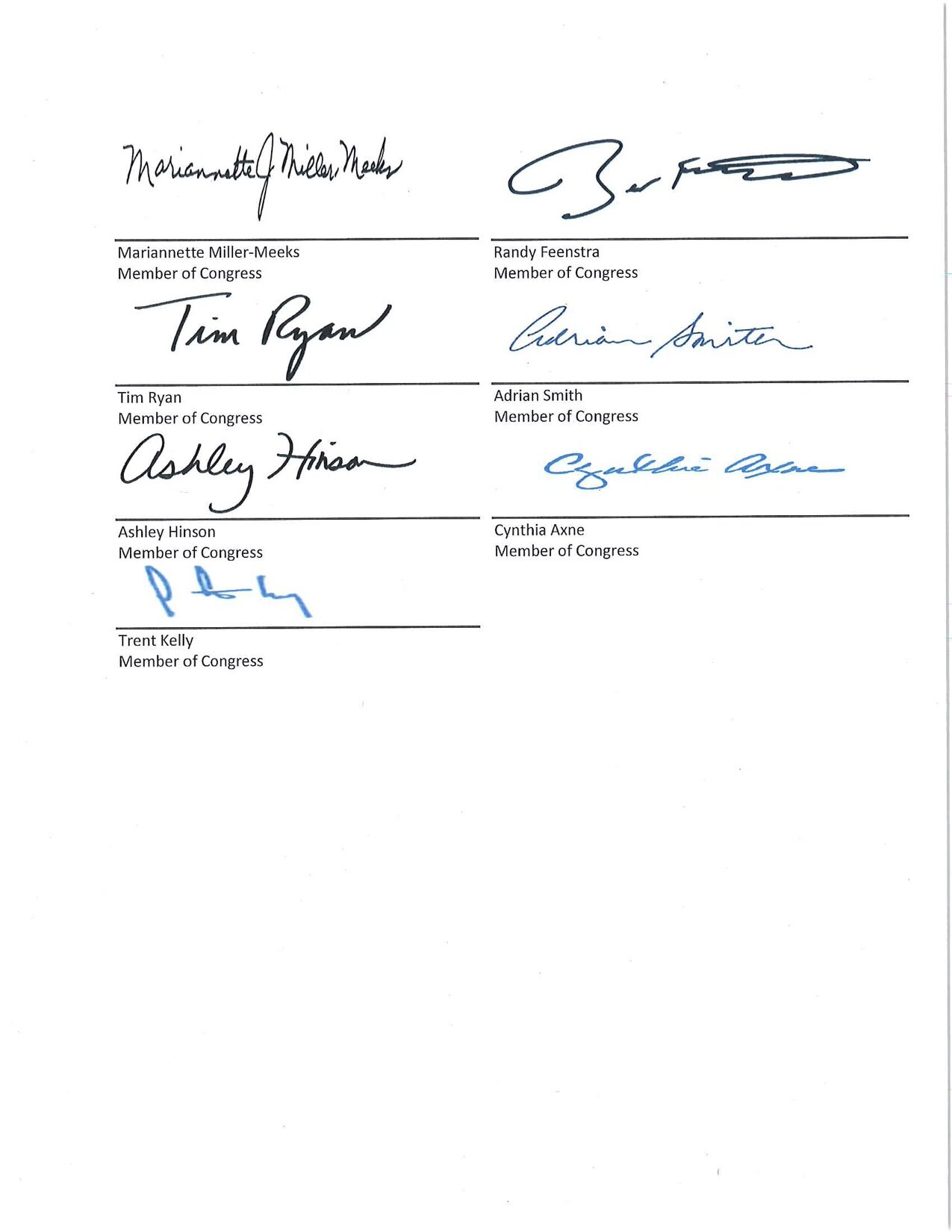
On March 17, 2022, a bipartisan group of 86 members of Congress wrote to ITC Chairman Jason Kearns and urged him to reconsider countervailing duties on phosphate imports from Morocco and to suspend the process of imposing new duties on urea ammonium nitrate (UAN) fertilizer from Trinidad and Tobago. See the attached letter.
In part, the Members of Congress wrote, “We urge you to reconsider the duties placed on phosphate fertilizer products imported from Morocco and suspend the current process to impose new duties on urea ammonium nitrate fertilizer from Trinidad and Tobago… At the end of February, all fertilizer prices were near record high levels. Eliminating these duties on fertilizer imports provides the most immediate opportunity for a near term, partial remedy to the high costs of fertilizer facing U.S. farmers…”
The Trade Alliance to Promote Prosperity applauds these Member of Congress for standing with American farmers and working to relieve and protect them from the detrimental impacts of phosphate and UAN tariffs.


Trade Alliance to Promote Prosperity Thanks U.S. Senators for Requesting Phosphate Tariff Petition be Denied
March 16, 2022
At the request of the giant Mosaic Company, the U.S. International Trade Commission (ITC) will soon decide whether to impose countervailing duties on phosphate imports from Russia and Morocco. These tariffs would greatly inflate the cost of phosphate fertilizers for American farmers, a product used on 60% of American lands under plow.
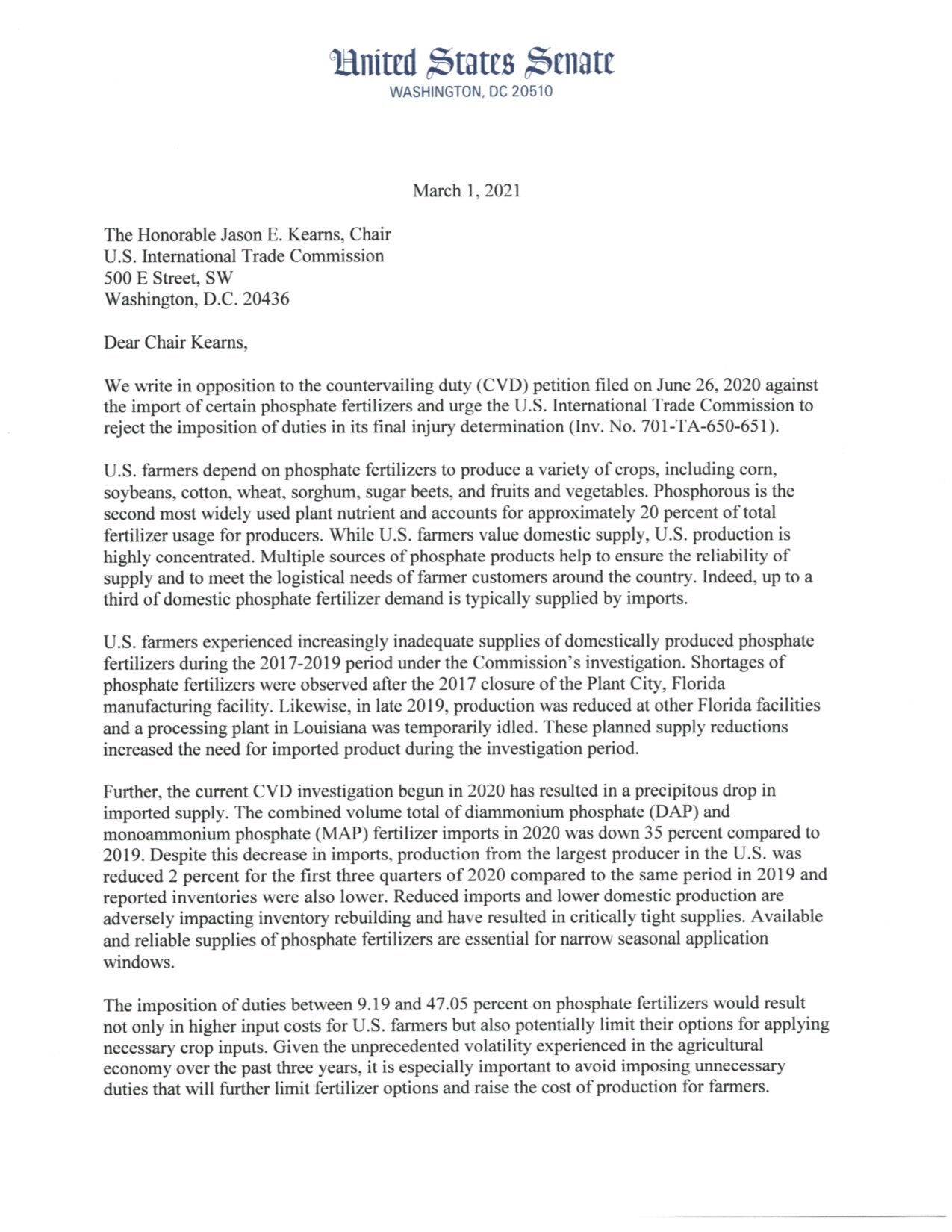
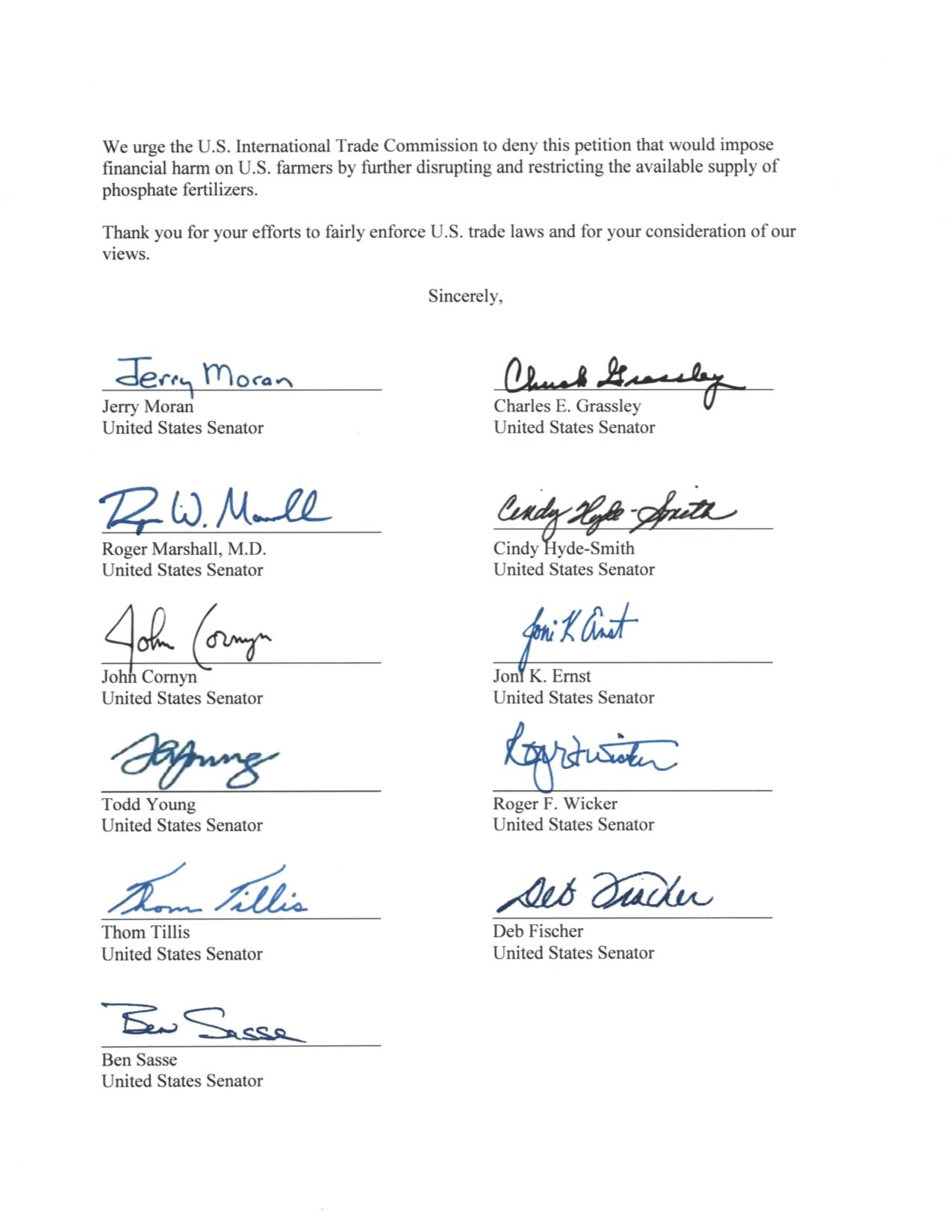
On March 1st, 11 prominent U.S. Senators wrote to ITC Chairman Jason Kearns and urged him to deny the petition. See the attached letter.
In part, the Senators wrote, “While U.S. farmers value domestic supply, U.S. production is highly concentrated. Multiple sources of phosphate products help to ensure the reliability of supply and to meet the logistical needs of farmer customers around the country.”
The Trade Alliance to Promote Prosperity thanks the Senators for standing with American farmers, and working to protect them from harmful phosphate tariffs.
Trade Alliance to Promote Prosperity Thanks U.S. Congress Members for Requesting Phosphate Tariff Petition be Denied
March 2, 2022
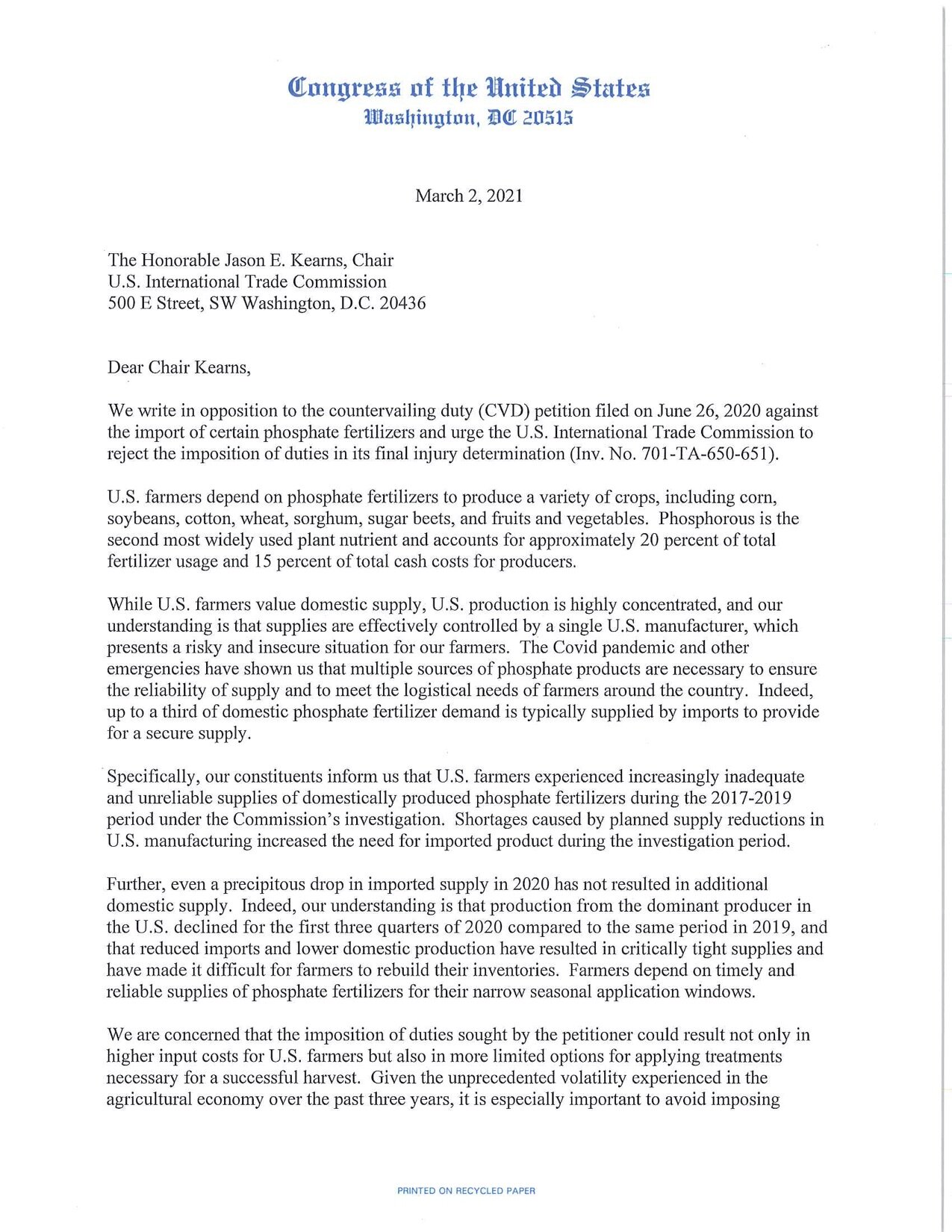
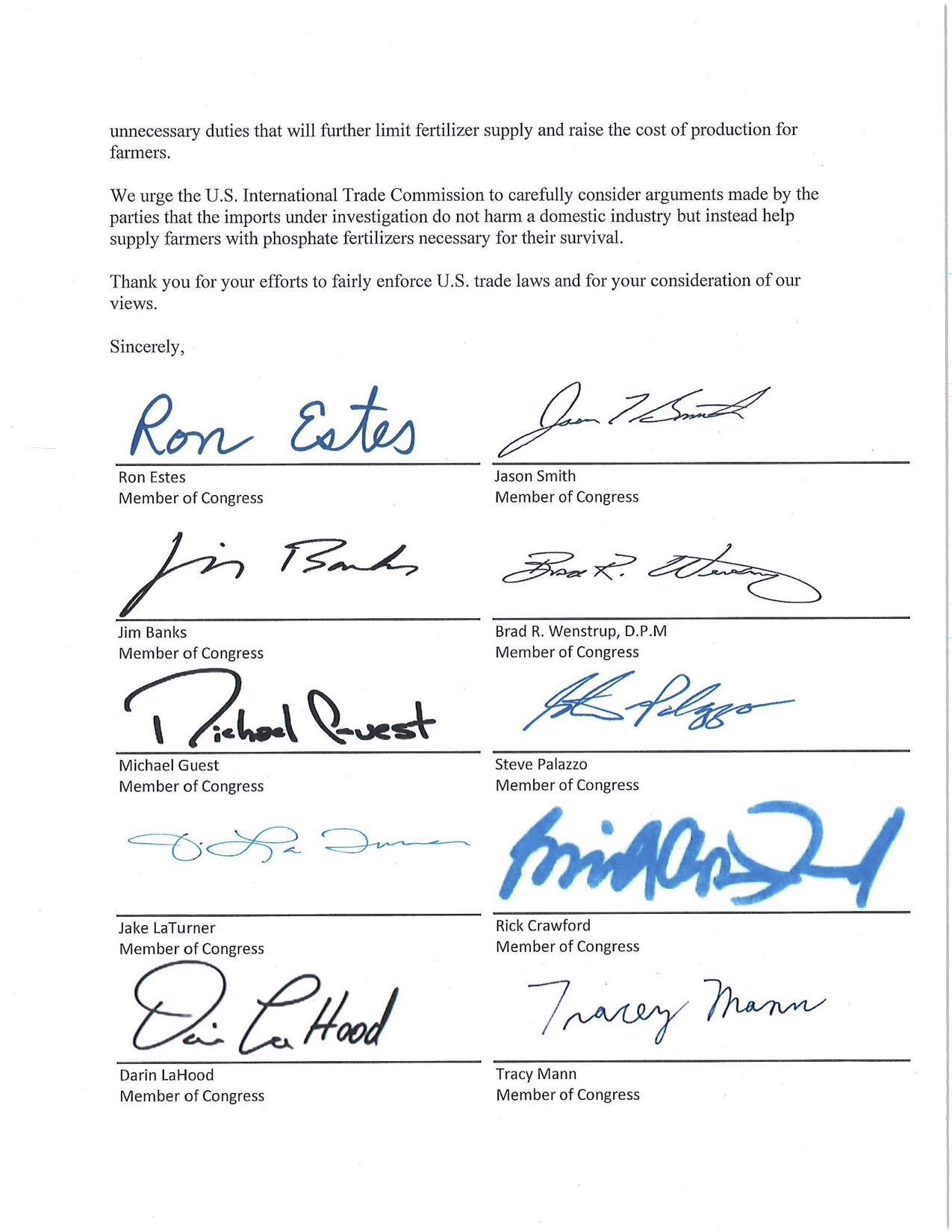
On March 2nd, a bipartisan group of 17 prominent members of Congress wrote to ITC Chairman Jason Kearns and urged him to deny the Mosaic Company’s petition to impose countervailing duties on phosphate imports from Russia and Morocco. See the attached letter.
In part, the Congress members wrote, “We are concerned that the imposition of duties sought by the petitioner could result not only in higher input costs for U.S. farmers but also in more limited options for applying treatments necessary for a successful harvest.”
The Trade Alliance to Promote Prosperity applauds the Congress members for standing with American farmers, and working to protect them from harmful phosphate tariffs.
Impact on Corn Growers from Imposing CVDs on Phosphate Fertilizer
September 15, 2020
Countervailing duties (CVDs) on phosphate fertilizer from Morocco and Russia would add between $100 and $250 per ton to the fob price of imported phosphate fertilizers. Based on the share of the fertilizer supply from imports, pro-rated by country market share, and the total domestic and imported supply, using the two-year average 2018-2019 fob Gulf price of MAP and DAP, the entire supply of phosphate fertilizers could see a $60 to $80 ton price increase.
This price impact could lead to an upstream $80 to $100 per ton increase in MAP and DAP fertilizer for farmers. For an N-P-K application rate of 180-70-70, that could mean a more than $7.60 per acre increase in production costs for phosphate fertilizers for U.S. farmers.
This would mean $10’s of millions in extra costs to corn growers across the Corn Belt and the country lowering individual farmers’ per acre returns. According to USDA’s latest Farm Income Forecast[1] issued 2 September, total cash farm receipts in 2020 will be their lowest in more than a decade, cash receipts for corn will drop $3.1 billion, fertilizer prices will increase $1.3 billion, and farm sector “Working capital, which measures the amount of cash available to fund operating expenses after paying off debt due within 12 months, is forecast to decline 12.8 percent from 2019.”

Resources
[1] https://www.ers.usda.gov/topics/farm-economy/farm-sector-income-finances/highlights-from-the-farm-income-forecast/
[2] USDA Economic Research Service percent of corn acreage receiving phosphate fertilizer, selected States
[3] calculated from Countervailing Duties on Phosphate Fertilizer Imports Will Hurt U.S. Farmers, July 2020, The Juday Group
Trade Alliance to Promote Prosperity Denounces U.S. International Trade Commission Decision to Continue Investigations into Moroccan and Russian Phosphate Fertilizers
August 8, 2020
On August 7, 2020, the U.S. International Trade Commission voted to continue investigations concerning phosphate fertilizers being imported from Morocco and Russia. The Trade Alliance to Promote Prosperity denounces this vote and the corresponding investigation.
The investigation reeks of crony capitalism, as it comes at the request of the giant Mosaic Company, which owns a majority of the phosphate production for fertilizers in the United States and a majority of the mines in Florida, where 75% of the phosphate in the United States can be found, according to the Florida Industrial and Phosphate Research Institute. Imposing tariffs on phosphate imports from Morocco and Russia would increase the prevailing cost of phosphates in the United States and allow the Mosaic Company, with its $19 billion-plus assets, to charge even more for its phosphate fertilizers than it already does.
The U.S. Department of Commerce will now pursue an investigation into imports of phosphate from Morocco and Russia and could ultimately decide to slap tariffs of approximately 30-70% on those countries’ phosphate exports to the United States. Those tariffs would amount to a tax on American farmers of roughly $480-$640 million, according to Bob Young, former Chief Economist for the American Farm Bureau Federation. Ultimately, this would result in higher costs for American grocery consumers.
The current investigation into and potential tax on phosphate fertilizer imports stands not only to hurt farmers but also to help a corporate behemoth to shore up its market majority in the country. The Trade Alliance to Promote Prosperity, therefore, calls on the U.S. Department of Commerce to abandon this investigation and any ideas about imposing tariffs on phosphate imports.
Trade Alliance to Promote Prosperity Applauds U.S. Senators’ Letter Requesting Phosphate Tariff Petition Be Denied
August 4, 2020
At the request of the giant Mosaic Company, the U.S. Department of Commerce is poised to decide whether to pursue an investigation into imports of phosphates, which are commonly used in fertilizers in American agriculture, from Morocco and Russia and could ultimately decide to slap exorbitant tariffs on those countries’ phosphate exports to the United States.
On August 3rd, eight prominent Republican U.S. Senators wrote to Commerce Secretary Wilbur Ross and International Trade Commission Chairman Jason Kearns and urged them to deny Mosaic’s petition. See the attached letter.
In part, the Senators wrote, “U.S. farmers depend on affordable phosphate fertilizers to produce a variety crops… The imposition of duties of between 30.72 and 71.50 percent on phosphate fertilizers, as sought by the petitioner, would result in higher input costs for U.S. farmers.”
The Trade Alliance to Promote Prosperity applauds the Senators’ responsiveness and echoes the sentiment: Tariffs on phosphates would amount to another unbearable blow to farmers.

PHOSPHATE TARIFF WOULD BE YET ANOTHER BLOW TO AMERICA’S FARMERS
August 3, 2020
At the request of the giant Mosaic Company, the U.S. Department of Commerce is poised to decide whether to pursue an investigation into imports of phosphate from Morocco and Russia and could ultimately decide to slap tariffs of 30-70% on those countries’ phosphate exports to the United States. Those tariffs would amount to a tax on American farmers. Indeed, the estimated economic impact of applying duties of 30-70% on Morocco and Russia’s phosphate imports would amount to roughly $480-$640 million in additional unexpected fertilizer taxes on U.S. farmers, according to Bob Young, former Chief Economist for the American Farm Bureau Federation.
The geographic breadth of the impact would also be enormous. One of the most common inorganic fertilizers is diammonium phosphate, which is used on over 60% of American land under the plow. It is used for growing corn, cotton, soybeans, sugar beets, and wheat, which collectively occupy the vast majority of the croplands in the country.
Why is Mosaic Company doing this, when it already owns a majority of the phosphate production for fertilizers in the United States and a majority of the mines in Florida, where 75% of the phosphate in the United States can be found, according to the Florida Industrial and Phosphate Research Institute? The answer is that imposing tariffs on phosphate imports from Morocco and Russia would increase the prevailing cost of phosphates in the United States and allow the Mosaic Company, with its $19 billion-plus assets, to charge even more for its phosphate fertilizers than it already does.
We have seen in recent years how trade wars, countervailing duties, anti-dumping safeguards, and other measures instituted by the federal government have backfired only to hurt the very farmers the government was purportedly trying to help. In the case of phosphate imports, the current investigation and potential tax on imports stands not only to hurt farmers but to help a corporate behemoth to shore up its market majority in the country.
The Department of Commerce should turn down the request to cause further disruption in the agriculture industry—farmers are facing a tough enough row to hoe.